
Why Rosacea Is Chronic, Not Curable

Among the most common skin conditions in the world is rosacea. Yet it frightens many people when they hear that rosacea has no official “cure.”

Why is this?

Rosacea is a chronic inflammatory skin condition. This means that, unlike conditions like acne, rosacea isn’t a “one-off” kind of condition that appears, gets treated, and permanently goes away. Instead, rosacea flare-ups occur periodically throughout a patient’s life. Some factors that can trigger rosacea flare-ups include heat and stress.

Rosacea is chronic because its mechanism involves the immune system, blood vessels, and nerves in the skin. That’s why current treatments focus on mitigating the symptoms instead of eliminating the condition entirely—it simply isn’t possible.
Despite this though, this isn’t to say that rosacea symptoms can’t be mitigated. They certainly can. Centella asiatica and azelaic acid are some commonly used skincare ingredients that can help calm inflammation/sensitivity and strengthen the skin barrier.

But for patients to treat their rosacea, it’s first necessary to identify it.

And for many individuals with darker skin tones, it does not come easily.

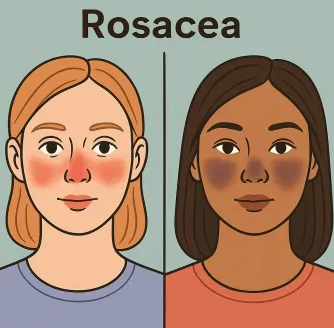
Rosacea is an inflammatory skin condition—meaning, it causes inflammation. And on lighter skin tones, inflammation typically manifests as red. But on darker skin tones, due to increased melanin levels, the inflammation color gets masked, instead appearing as purple or gray.

As a result, rosacea in darker skin is more likely to be overlooked or misdiagnosed, even when symptoms are present.

What can be done?
While there’s no official cure for rosacea, lots of people can control symptoms once they know they have it. Usually, this can involve calming skin inflammation, caring for the skin barrier, and avoiding triggers for rosacea. Simple skin care, regular moisturizing, and using soothing ingredients like azelaic acid or centella asiatica are especially helpful. In some cases, doctors might suggest prescriptions or special skin treatments. But overall, keep in mind that treatments for rosacea vary from person to person.

References

American Academy of Dermatology (AAD) page
People with darker skin tones can get rosacea. American Academy of Dermatology, 11 Jan. 2023, www.aad.org/public/diseases/rosacea/what-is/skin-color. Accessed 2 Feb. 2026.

Healthline article
Lockett, Eleesha, and Bukky Aremu. “Rosacea on Black Skin: Symptoms, Treatments, and More.” Healthline, 29 Jan. 2026, www.healthline.com/health/rosacea/rosacea-on-black-skin. Accessed 2 Feb. 2026.

Peer-Reviewed Journal Article (PMC)
Maliyar, K., et al. “Dermatology: How to Manage Rosacea in Skin of Colour.” Journal of Dermatological Treatment, vol. (include volume/issue if available), 2022, pp. (include page numbers if available), PubMed Central (PMC), pmc.ncbi.nlm.nih.gov/articles/PMC9165629/. Accessed 2 Feb. 2026.
Why Vitiligo Looks So Different on Dark Skin—And Why Doctors Keep Missing It

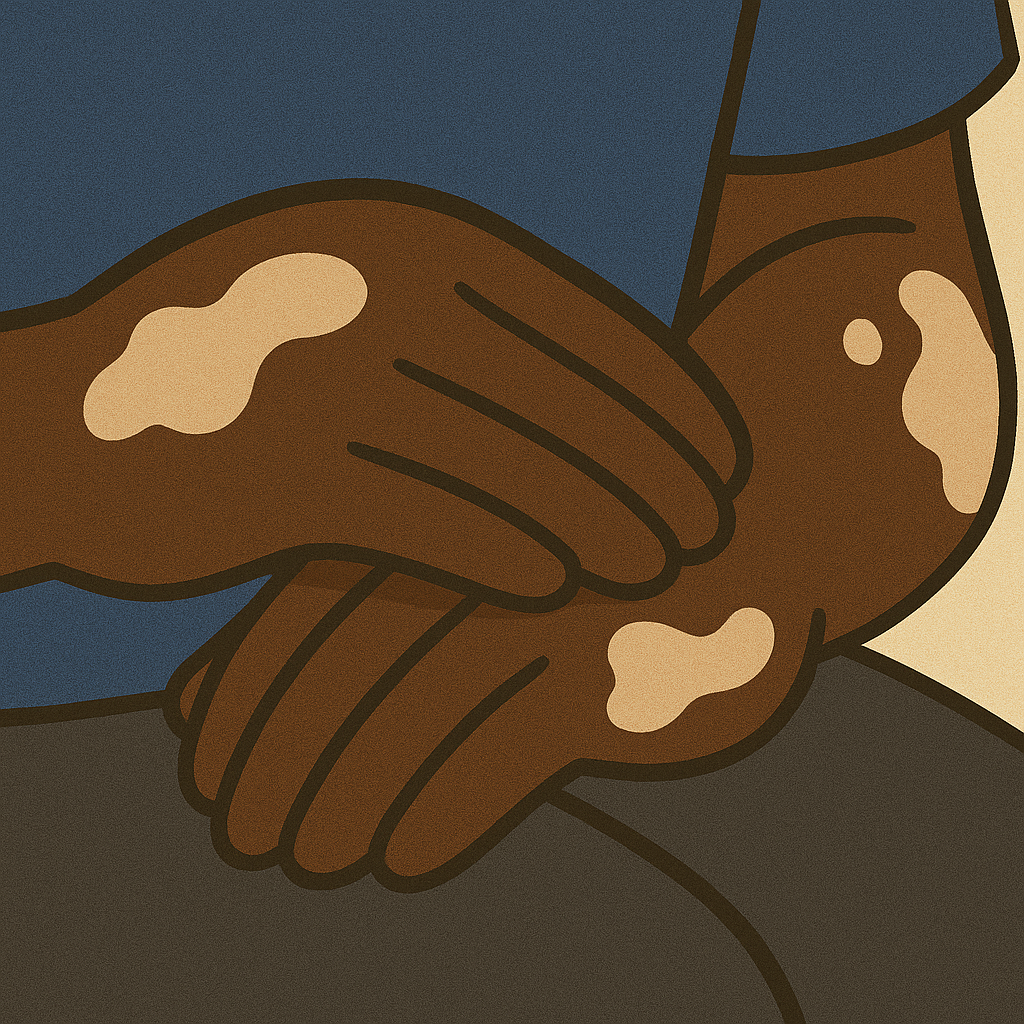
Vitiligo is a chronic skin condition that causes the formation of white patches of skin that may appear anywhere on the body. This condition can show up in all races more or less equally, but can be especially more visible—and sometimes more difficult to treat—in darker skin due to the strong color contrast with normal skin. Unfortunately, medical cosmetics and dermatological literature have most often dealt with lighter skin types, leaving both patients and practitioners poorly informed. This article discusses the biology of vitiligo, the way color functions in the skin, and why vitiligo differs in people with darker skin.

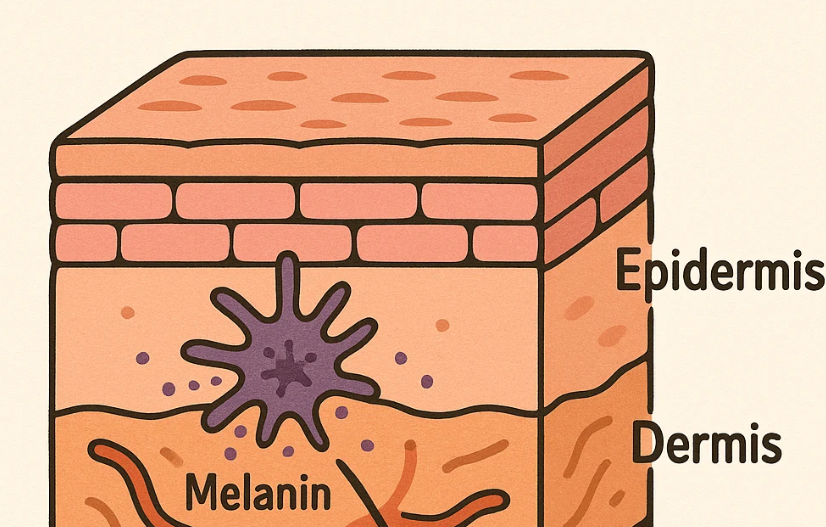
Simplified diagram of a melanocyte

What is vitiligo?

Vitiligo is a chronic, autoimmune disease. In other words, the body’s immune system incorrectly attacks the body’s own cells, in this instance called melanocytes. Located in the skin’s outer layer (epidermis), these are cells that have the special function to produce melanin!

Melanin colors the skin, hair, and eyes. Where melanocytes are lost or are not functioning, the areas involved lose their pigment and turn milky white.

Vitiligo is one of two types: non-segmental (more common and occurs on both sides of the body symmetrically) or segmental (less common and is typically on one side of the body). The disease is neither painful nor contagious, but can be devastating to one’s self-esteem.

How Skin Pigmentation Is Formed

In order to find out why vitiligo appears more on darker skin, we have to examine how skin color is created. Melanocytes produce melanin and package it into small organelles known as melanosomes, which are transported to the surrounding skin cells. We all have roughly the same number of melanocytes, but in darker-skinned individuals, the cells are more active and produce more melanin.

When people with darker skin lose pigment, the contrast between the light spots and the rest of the skin is so much more pronounced. In light skin, the spots may be quite light or pink.

Why Vitiligo Appears So Different on Dark Skin

Dark-skin vitiligo patches tend to be very noticeable and snow white, attracting more attention than they would if they were located on light skin. In fact, most dermatology textbooks and instructional photos of skin diseases show vitiligo in light skin. This contributes to the delayed or erroneous diagnosis of the disease in darker patients.

Inequalities in Skin of Color Diagnosis and Treatment

Vitiligo may be misdiagnosed in dark-skinned patients as another skin condition, such as tinea versicolor, post-inflammatory hypopigmentation, or chemical leukoderma. This is particularly so for physicians who are not used to dealing with dark skin. After proper diagnosis, treatment may involve creams with corticosteroids, calcineurin inhibitors (such as tacrolimus), and narrowband UVB phototherapy. Depigmentation therapy may be considered for severe cases. But not everyone chooses to get treated. Most individuals would prefer to accept the way they appear and search for makeup products that will enable them to hide their imperfections. Even then, very few makeup or concealer products are suitable for dark skin.

Closing Comments 

Vitiligo is not riskier on darker skin, but can be readily noticeable, less understood, more frequently, and under-treated or mistreated. Diversity role models, more medical training, and education are the solutions to all of these problems. If you or your relative has vitiligo on darker skin, you need to know that help is growing—and your skin’s narrative needs to be told accurately and with pride.

References

Pietrangelo, Ann. “Vitiligo on Black Skin: What You Should Know.” Medical News Today, Healthline Media, 28 Oct. 2022, https://www.medicalnewstoday.com/articles/vitiligo-black-skin.

Cleveland Clinic. “Vitiligo.” Cleveland Clinic, 13 Oct. 2023, https://my.clevelandclinic.org/health/diseases/12419-vitiligo.

Hitti, Miranda. “What People of Color Should Know about Vitiligo.” WebMD, 6 June 2023, https://www.webmd.com/skin-problems-and-treatments/features/vitiligo-darker-skin-tones.

NHS. “Vitiligo.” NHS, National Health Service UK, 13 Feb. 2024, https://www.nhs.uk/conditions/vitiligo/.

Goldman, Lisa Zamosky. “Vitiligo and People of Color: The Nuances of a Visible Condition.” WebMD, 6 June 2023, https://www.webmd.com/skin-problems-and-treatments/features/vitiligo-poc-nuance.