

What is eczema?
Eczema is a common skin condition characterized by inflamed, itchy patches of dry and scaly skin. This chronic condition affects roughly 10% of the US population. These patches result from a combination of environmental triggers and immune system reactions, often with a genetic predisposition. There are several types of eczema, including atopic dermatitis—the most common type—and contact dermatitis, among others. The key difference between atopic dermatitis and contact dermatitis comes down to the underlying cause and immune response. Atopic dermatitis is a chronic condition that can be triggered by both external factors and internal influences, such as stress, but is ultimately caused by genetic and immune system factors. In contrast, contact dermatitis is an acute condition that is directly caused by irritants like soaps or chemicals and can easily be prevented by avoiding said irritants.
Who suffers from atopic dermatitis?
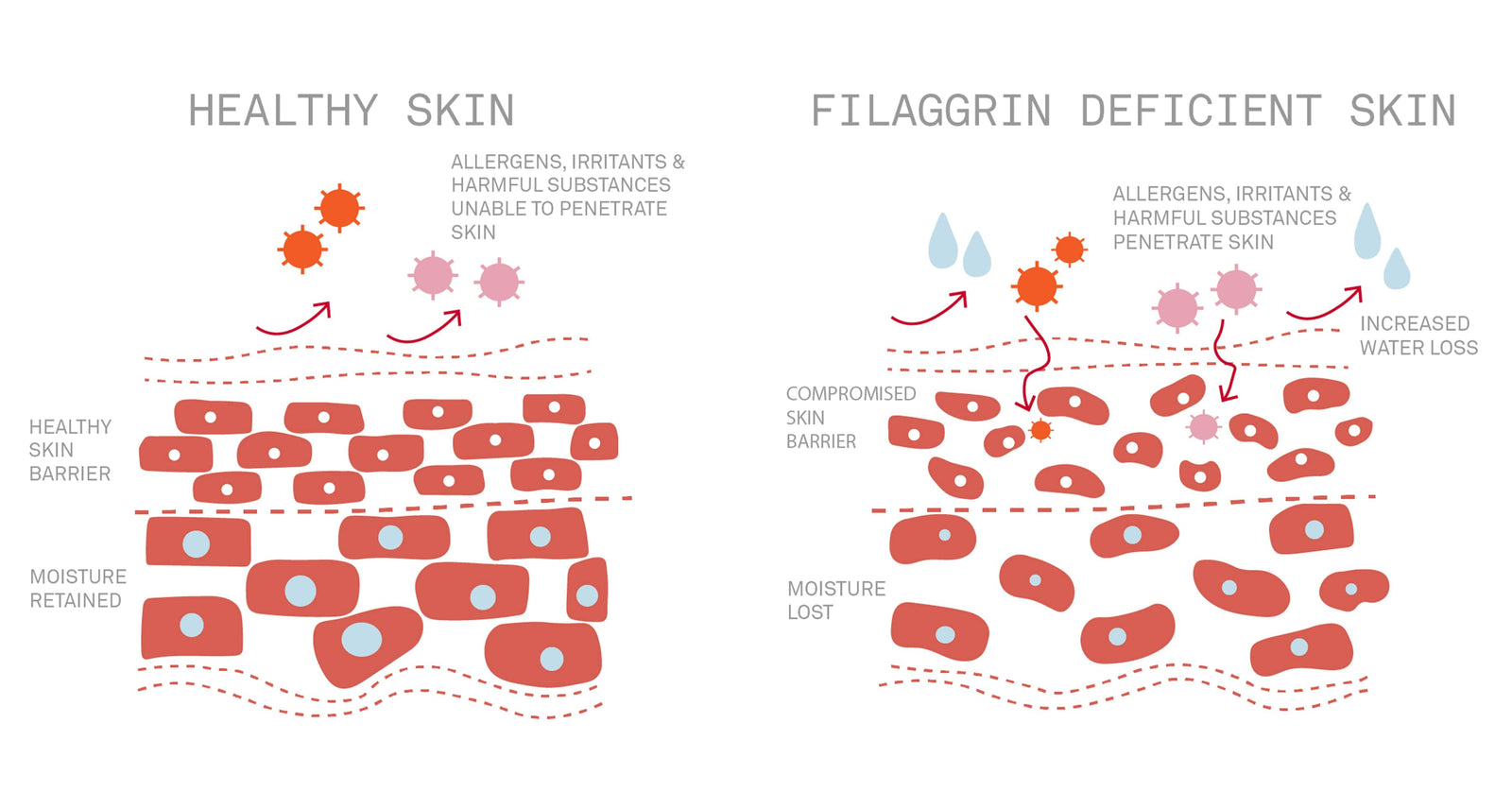
The integration of genetic mutations and a hyperactive immune response in individuals with atopic dermatitis leads to persistent eczema flare-ups. In particular, these individuals have a loss-of-function genetic mutation in their filaggrin gene—one of 70 genes comprising the Epidermal Differentiation Complex—which is crucial for maintaining the epidermis and protecting it from allergens and irritants. This genetic mutation causes the affected individual to produce less filaggrin protein, ultimately resulting in a compromised skin barrier and increased susceptibility to environmental triggers. This single filaggrin defect leads to a cascade of dysfunctions in the body, including reduced natural moisturizing factor levels and a hyperactive immune system.
What happens during a flare-up?
An atopic dermatitis flare-up is a multi-step process that begins with a trigger—environmental factors, irritants, allergens, etc. Because the skin barrier of these individuals is compromised and more susceptible to infiltration, allergens and irritants can penetrate more easily. Once the trigger reaches the compromised skin barrier, antigen-presenting cells capture the trigger and carry it over to the local lymph nodes. Lymph nodes are organs that house various immune cells that help coordinate the immune response. T cells – a key type of immune cell – activate and then identify the trigger to initiate the release of cytokines—signaling proteins that—when overproduced—are primarily responsible for the redness and inflammation associated with atopic dermatitis.
How do topical medications alleviate flare-ups?
The complex combination of genetics, environmental triggers, and the immune system makes eczema uncurable, although its symptoms can be mitigated. Topical steroids and inhibitors are commonly used to manage inflammation in conditions like atopic dermatitis. Topical steroids are applied directly to the skin, where they enter cells and bind to receptors in the cytoplasm. This binding triggers the formation of a steroid-receptor complex, which then migrates to the nucleus. In the nucleus, the complex binds to and modifies specific DNA sequences, including the one to reduce the production of inflammatory cytokines. This process helps alleviate redness, swelling, and other symptoms of inflammation.
On the other hand, topical inhibitors reduce inflammation by binding to a protein in T cells, creating a complex that inhibits calcineurin, an enzyme responsible for promoting cytokine transcription and T cell activation. Although these topical treatments yield similar results, their function is very different, so prescription of either should be done by a healthcare professional.
Bibliography
National Center for Biotechnology Information. “Chemical Bonding and Molecular Structure.” NCBI Bookshelf, 2019, https://www.ncbi.nlm.nih.gov/books/NBK538209/.
Wang, Y., et al. “Molecular Insights into Chemical Interactions.” PLOS Computational Biology, vol. 17, no. 2, 2021, e1008623. https://pmc.ncbi.nlm.nih.gov/articles/PMC7880084/.
“—.” American Cancer Society, www.cancer.org/cancer/diagnosis-staging/lymph-nodes-and-cancer.html#:~:text=Lymph%20vessels%20send%20lymph%20fluid,filter%20fluid%20in%20those%20areas.
National Eczema Association. “Eczema Topical Treatments | National Eczema Association.” National Eczema Association, 4 Mar. 2022, nationaleczema.org/eczema/treatment/topicals.